Loser's Guide to Life
Frédéric returns to his village after a long absence.
The arrival of a new saucier changes everything.
After joining forces to defeat Gevicius, Pepi and Bosanquet learn that they're not so different after all!
Labels: Cinema
Speaking of someone not writing about what they know, I've just seen a good example in Lars von Triers' “Dogville”.
 |
For a start, making a story about a town is always a bit dodgy. It slips into easy allegory and the faults in that—the very frailty of attempted allegory—threaten to make nonsense out of everything.
Then the whole stage idea: I think you get unintended effects. It calls attention to itself, so you'd better have cast-iron ideas and actors to play with, and this doesn't. The argument is very thin. I really can't help thinking that the director himself and his writers didn't have a clear idea of what they were doing, but were more in love with the concept. I also think the lighting and the props weakened it further. What's the value of having people being raped in (as it seems) full view of people in the street?
Then the sub-Brechtian stuff, with very weak, worn-out smug unfunniness such as “...Elm Street—though no elm had ever cast its shadow in Dogville”, “Being a man of many ideas and proclivities”, and the chapter subtitle gag, which was somewhat funny when the Beatles did it in “Chapter One, In Which Doris Gets Her Oats”, but is nothing but tedium now.
Then the faux-folksy dialogue lifted from old movies and bad old plays: “Don't give me any of your lip, Thomas Edison Junior.” All this stuff ripped from Faulkner or some other bore.
Those might seem like trivial things, but they are very hard to get past when the movie itself isn't doing anything. Also, it's doubly fucking annoying that somebody thought that this might be amusing, and it's triply fucking annoying that there are gasbags who do find it amusing and encourage this garbage by buying tickets and acting as a claque for the director. They ought to stay home and chuckle over G.B. Shaw.
Then there's the setting problem. Are these people farmers or miners or what? How do they live? Why are they wandering around the streets all day? Where could they be going? For that matter, how come the cops are unfamiliar with the town and its people?
And the general theme, as far as I understand it, is piddling. The townsfolk were wicked, so they get destroyed by their former victim? Who cares? Seriously, so what? That's a problem with vengeance things. It's like a story about a guy who got stung by a bee so he swatted it. Zzzzzz.
Labels: Cinema
I saw a terrible Canadian movie last night, La Vie avec Mon Père, about this old writer who lives in a big messy house in very boring Westmount, and his two sons who come to stay with him, one son is a wannabe writer and layabout, the other is head of some pharmaceutical company. The dad is old chiefly. That's his role. He used to be a ladies' man and still pursues female doctors or has visions of the subway full of naked women, but that's all the character provided.
See? Sex, old age, death—brilliant, no? Let me out of here.
Anyway, each of the characters has the exact problems that you would expect would be assigned to those stereotypical characters! Writer-wannabe: taking drugs, smoking, typing, whacky, has understanding girlfriend; business-head son: stiff, strict, has cold lawyer wife; his heart melts though when confronted with dad's aging and disintegration.
But what really caught my attention was the sheer truckloads of money spent on this. Everything was all lush: candlelit scenes, every intake of breath is heard, overhead shots of skaters, lots of “interesting” music. The old man has three big dogs, a mastiff, a baskerville and an afghan, and there are some scenes where they are in the kitchen with the people, so you can hear them (for some reason) slobbering on bones and puffing away. I think they must have spent a lot of money on the old dad's house, temporarily turning a large, well-appointed place in Westmount into a shabby, rambling, cluttered old writer's house. They would have had to hire experts in that sort of thing, people who really have cool ideas about old writers and know where to get the necessary props. They did all that for this dumb story.
Then at the end, the two sons ... discover ... that they are ... something.
Labels: Cinema
Sometimes it seems too easy to be snarky, and not every target is worth the effort; but in the hands of a good practitioner, and in an important cause, it is efficient and informative: Anthony Lane on Diane English's “The Women”:
The wordplay is matched by the fatigue that pervades both the musical and the visual vocabularies: in the opening credits, an over-the-river travelling shot of the Manhattan skyline gives way to a closeup of heels and toned calves, hymned by a voice singing “I’m Feeling Beautiful.” At the other end of the story, I just about clung on, consoled by the thought that, whatever else, Diane English had at least found the decency not to stoop to a birthing scene. Then it was time for the birthing scene.
Labels: Cinema
I recently saw The Yards (2000), a strangely low-key drama directed by James Gray, with “Whackin'” Phoenix, Mark Wahlberg, James Caan, and Faye Dunaway. It's a well-made, unusually realistic, drama, the sort of thing that would have been a classic if it had been made in the 1950s, but it comes across as rather dull. The story is neither here nor there, which is of course no big offense, but I think the problem is the gritty earnestness of the dialogue. Sure, it's believable, and very refreshing. But it's dull. If the story is not twisted and bizarre, and if the setting is the planet Earth, then you have a huge challenge on your hands: how to make this interesting? All of a sudden you have to have thoroughly engaging, even poetic, dialogue, and well-placed dramatic scenes, like in a really good play or something! Otherwise ...
It's unfortunate, but a good and reasonable movie has to be even better than average to be any good. That's probably true of a lot of things.
Labels: Cinema
I saw Seconds (1966) a few evenings ago. Someone recommended it highly, and I was trying to think if I hadn't already seen it at some point. How could I have missed it? And if I had seen it, how come it made no huge impression on me? Having watched the movie, I can say that bits of it do seem familiar, but it has some aggressivley unmemorable features that can cause an erasure through boredom in the viewer's mind.
John Randolph, a typical unhappy businessman who, at times, has a camera attached to his back, is accosted at the station by someone who gives him a scrap of paper with an address on it. Goes home, wife, gets anonymous call, “How would you like to start your life over except in Rock Hudson's body?” He goes to the strange organization, waffles, gets remade, etc. His new life commences. That's very interesting. And then ...
Now played by Rock Hudson, he meets an awful woman on the beach, who encourages him to seize life, and then takes him to an actual neighbourhood Bacchanalia. He dives into this new life with alacrity. But then he hosts one of those parties they used to have in movies of the period: lots of strangers standing around drinking martinis with an unobtrusive (and, in this case, invisible) jazz trio in the background. He gets drunk, becomes unhappy with his new life. And so on. Rod Serling frowns and looks on in faux disappointment, but actually licking his chops.
The theme is very interesting, and both the look of the movie and its pace are above reproach. There are plenty of things to admire. But it is strangely uneven. There are parts that don't work at all. There are bits missing. And there are lost opportunities in sequences that ought to have talked about the story but instead contain nothing but tat.
Parts even struck me as a rush job. There's a startling continuity error where Rock Hudson is given a pillow on the airplane: we see Hudson put the pillow behind his head, we see the hostess smiling at him, and then we turn back to Hudson to find he obviously has no pillow. I quite thought for a moment that this was to herald some kind of mental confusion sequence, but no. It's just a mistake, and a glaring one. Normally that's no big deal, but here it underscores the host of things neglected by the director: what's going on in this man's mind? What happens when you start a new life? What would the sensation be like? Do things look different? The same? How would you feel about that? Do you still like your coffee with two sugars? What? There are all manner of things that ought to happen but don't.
Contrast that with the good dialogue scenes between John Randolph and the owner of the company, or between Hudson and Frances Reid, his former wife. Not only well composed but even daring, trusting the actor's ability to keep the audience transfixed for long seconds with his tormented silence.
Here, as well as I can recall, is the owner of the life-replacement establishment quizzing Randolph on his possible reasons for remaining in his current life, asking if there is anything of value left for him:
“Anything?”
“ ... I have my boat in the summmer ... I ... [jowl twitch]... friends!! ...”
“... Anything at all?”
I think all the acting is remarkable, and John Frankenheimer's work with his actors is the outstanding achievement of this film.
Labels: Cinema
Buddy was sitting in the theatre one evening, growing more and more indignant. He looked around at the other moviegoers: they showed no signs of impatience, but continued to stuff handfuls of flavoured popcorn into their mouths, scarcely moving their eyes from the screen even as they sought their jumbo drink straws in the darkness. Pop. Slurp. Crouche.
“What is all this?” thought Buddy. “They just sit there, as if ...” He turned his attention to the screen. It was Sandra Bullock, chambering a round in her futuristic (and rather unwieldy) space weapon. “Those aren't real people,” thought Buddy, “I know who they are. They're just ... actors. That's Sandra Bullock. Not an astronaut. Nor even a very good actor. And these events can't possibly be happening. It's—it's staged, somehow. It's set up to look plausible, but that's what it is, a set-up! Christ Almighty, the fiends! Who would have imagined, in their wildest dreams, that such a thing were possible, and on such a scale? I could kick myself—that crazy guy outside the drugstore was right all along. To think I ridiculed him, gave him short Schrift, pooh-poohed his ideas. Although talking to Jesus on your obviously non-functioning cell phone does nothing to help your credibility. But he was right. Nevertheless, he was right. It is a vast conspiracy.” He fidgeted in his seat. It was probably best to sneak out.
In the lobby, he said to himself: “Who knows what other fictions are out there? Look at this now.” There were large movie posters encased in special frames on the walls, or installed in free-standing displays. “What if all those films are like that? You know—I'll just bet they are. These stories are bogus. Somebody just made it all up.”
He headed for the escalator, trembling with rage. “And getting mad isn't enough. No, it's time for action. In fact, my movie is starting right now!” And he whipped out his camcorder and started filming random people on the escalator, a man in a business suit, a student, a senior. People screamed and ran for cover.
Labels: Cinema
No one in a movie can ever just figure something out for themselves. It's always some catastrophic event in their immediate personal life that causes them to learn something. For example, in Traffic, the new DEA head doesn't really make much headway in thinking about drug use and the advisability of a huge multi-level war on drugs until his kid gets into trouble. Hasn't given it much thought.
It's an interesting movie otherwise, and I honestly don't see how you could make the same point without having that little family drama in the centre, yet the implication is a little bleak. How much experience can one person have? You go about your business day after day, selling T-shirts, designing tattoos, drinking Andrés Rich, and what do you learn of the great world that's out there? How likely are you to know anything of it from direct experience? In fact, isn't the secret of competence the ability to recognize and understand situations you haven't seen before? For example, how likely is the Minister of National Defence to know anything important about war? Of course, the current one, Gordon O'Connor, knows a thing or two, having been a lobbyist for General Dynamics, BAE Systems and Airbus. But that's unusual.
Labels: Cinema
Quite a few movies employ the narrative structure found in the old jokes about the guy who walks into a bar with whatever, and the bartender asks, “Whoa, buddy, how did you get”, etc. For example, we're confronted with a man drowning in a lifeboat, and in voiceover he muses “Strange to imagine that a few weeks ago I was perfectly happy working in an insurance office. But it all started when ...” and we go back to the beginning of his story to view the unusual (though logical) process that took him from his innocent suroundings to this sinking boat.
In Betrayal, the plan is similar: we see an unhappy situtation, and the path to it is illustrated in several segments progressively further back in the past. It's really the same as the boat example but with multiple, sequential instances. It works in Betrayal because the movie charts the changing relationship of three people via several slightly different situtations, and not a simple chain of events. If anything, it emphasizes how people are the authors of their own fate, especially if we consider fate to be the general predicament of one's life, and not some catastrophic eventuality. (E.g., being generally miserable as opposed to drowning.)
Now what happens if you play around with this, as Quentin Tarantino has done? I think the danger is that the siuzhet writes more cheques than the fabula can pay. It's still entertaining, of course. But it's a little like watching a terribly amusing ad. I laughed myself sick last year over these two ads for (I think) a car and some kind of cereal. But I don't drive and I never eat cereal.
A few nights ago I watched a movie called Chasing Sleep (2000). It's hugely promising: guy who suffers from insomnia wakes up to find his wife missing. Next the cops are at the door. He spends the whole movie in his deteriorating suburban house wondering what the hell happened and how the, uh, that thing ended up in the bathtub. But here I think the writer ran out of narrative. He must have thought, “Well, did my hero kill his wife or not?”, but he hasn't done much one way or the other. There appear to be time lapses in the story: one minute it's afternoon, the next it's nightfall, but it's not clear that anything significant has happened in those periods. Some of the characters also appear to be imaginary, but we're out of time before this can be resolved.
This is a case where you could probably improve the story by making the order of events (as presented) more ambiguous, as in Memento. Otherwise the viewer remains just as baffled as the poor hero.
Labels: Cinema
Last night TV5 offered Les Brigades du Tigre (2006). This was apparently a TV series in the 1970s but I don't remember hearing of it. There were a couple of historical drama series back then which I found rather dull, though. It's hard to convey a period in a TV series for some reason, maybe because the really good work is just too expensive. The actors always look like modern people dressed up in period costume, as if they're just not comfortable with celluloid collars and waistcoats and so on. The set seems awash with props. Oh, look, now he's getting into his quirky old historical automobile and adjusting his spanking-new prewar cloth cap. Riingkx!Pocka-pocka-pocka-pocka, as the engine starts. Mind you don't run over the kid in the sailor suit playing with his hoop! Or M. Seurat, who's pointilising the scene for posterity!
Les Faucheurs de Marguerites (1974) is the one I do remember. That's to say, I remember seeing a lot of ads for this tiresome nonsense about Édouard Dabert and his aviation pioneer chums. They were always running around in the fields trying to get their aeroplane to fly, and when they succeeded, it was a time to rejoice by rippping your cap off and hurling it to the ground and hugging someone. There was also a mixed choir humming along dramatically at these moments.
But to be fair, it was nowhere close to D'Iberville (1968) for outrageous, smouldering cauldrons of boring anti-entertainment. That was a piece of work. Coming home from school to find nothing on TV but those guns firing out of the side of a ship and the little trumpet flourish as the title “D'Iberville” unfurled across the screen, that was a letdown. And once again, Frontenac would be confronting someone in a wig with an important piece of paper.
This movie, however, was not bad, if a bit complicated. Actually, the story was that interesting that it would have been better to have spent less time on the brigade (an early motorised police squad) and a bit more on the villains. And, I guess, the story.
Michael Madsen, the man with the razor in Reservoir Dogs, is actually a poet. He has published four books. Here's a poem called “Hammerhead”:
Man, I think the hammerhead shark is the
most bizarre looking creature I've ever seen.
What is the deal with that head?
Some more information at The Guardian
Labels: Cinema, Hammerhead Shark Poems
At work he walks through the morgue with his flashlight, briefly looking at each still form. Nothing. Walks through again. This time ... he thinks he hears something. Looks at each form. Nothing. We hear nothing except air. He listens closely. Can he hear something? We don't, but he looks as if he's trying to hear something. We hear ... just air, and then the slight movement of his clothing as he turns. He holds his breath to listen. What is he listening for? Nothing. Then we (and he) hear a small “tick”, but towards the back door. He turns. Nothing there. Most likely the click of a heating pipe. He goes to the back door. We watch him from behind as he investigates. We are watching from over his shoulder. We move a bit closer to him. In another minute it seems as if something must, must, put its hand on his shoulder. Horror movie ethos is just crying out for it. But no. He is squatting looking at something with his flashlight. He stands up. Okay, this time, we know, when he turns back towards us he will be confronted face to face with the thing! But no. He goes back to his table in the corridor.
He works at his crossword puzzle, something new. He puts in a word. “Look”. “Coffee”. “Paxil”. That's odd ... “Undead”. No, that can't be right. But it seems to be.
He hears a definite “thud” from somewhere. He gets up from his table. Is it, uh, the morgue? Not afraid of it before, but lately ... he stands in the corridor listening. Nothing. He is waiting for a repeat of the thud, to see where it's coming from. We keep expecting he'll hear it at any moment. But he doesn't. However, he goes into the morgue. Everything is normal. But one of the gurneys is empty. That doesn't mean anything: sometimes, during the day, the corpses come and go, and not all the gurneys are occupied. But this stops him a bit.
Who are these people? He hears a distinct chuckle. Looks around. Nothing is moving...
Next: More stuff that will happen.
Labels: Cinema
Kinograf writes:
Il Tempo Si E' Fermato (Time Stood Still) (1959; dir./writer: Ermanno Olmi; 83 min.)
The curious thing about this spare and, at times, humorous movie is that it followed hard on the heels of those works by Ermanno Olmi which were purely industrial studies: “Cavo ad Olio Fluido a 220.000 Volt”, (“220,000 Volt Fluid Oil Cable”), “Fertilizzanti Prodotti dalla Società del Gruppo Edison”, (“Edison Group Fertilising Products”), and “Natura e Chimica” (“Nature and Chemistry”), for example, which all appeared in the same year.
But here, in the minimalist story of a young worker learning the ropes from his senior at a remote hydroelectric station, it is as if man, the putative master of his works, finally makes an appearance in their midst and is set up for some sort of confrontation. At first there is quite a lot of the usual roommate/coworker friction, as the older man gapes in disbelief at the other's mollycoddled outlook and incomprehensibly casual approach to the work. But the man-nature confrontation soon comes in the form of a heavy snow storm, and the two put aside their differences and learn to work together. What at first seems to be the age old insoluble problem of personal space and generational discord is shown to be nothing in the face of several hundred thousand cubic feet of snow.
Labels: Cinema
Orlac, the noted strangler, loses his hands in a train wreck; he receives a transplant of a pair of hands belonging to a recently-executed concert pianist. Then he begins a strange journey of redemption, giving concerts and making recordings. “'L'Isle Joyeuse' has never sounded so convincing as when played by a strangler”, one critic writes. “He wrings a strange passion from Debussy”, etc.
However, our movie will need some sort of peripeteia to be whole. Either: a) He woke up and it was just a dream; or z) He is in another train wreck, this time only his hands survive. Released from the hospital, the two hands tour the country with a novelty act and drum up support for better train safety regulations.
Oh. Probably everyone has heard that “L'Isle Joyeuse” is inspired by a painting of Watteau, but few are aware that Jersey could also be the “Isle” that Debussy was thinking about.
Labels: Cinema
People slowly approaching the camera though thick fog for long minutes of opening credits.
People silhouetted on a hillside.
Someone doing something in the yard viewed, for no reason, from inside the (irrelevant) barn through big cracks in the wall.
A dusty window in a farm building, interior, somebody's retarded face looking into it from the outside, it having been established that the building is abandoned.
Any character who has to walk with a bad ankle, leg, knee, whatever. Shoot them.
Labels: Cinema
C'est arrivé près de chez vous (1992)
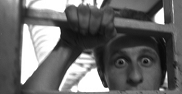
Meditations on city planning and a changing population as they affect the average serial killer.
aka Man Bites Dog. Rémy Belvaux, dir.; with Benoît Poelvoorde, Jacqueline Poelvoorde-Pappaert, Nelly Pappaert, Hector Pappaert. 96 min.
A serial murderer goes around murdering people seriatim, followed by a documentary crew.
I was afraid this was going to be one of those movies where you have to pretend to be in on the joke to avoid seeming like some kind of bore, but it does work, chiefly because of the abilities of Benoît Poelvoorde as the killer. Also there are no attempts at broad humour or stale mockumentary effects. Instead, the film is staightforward and realistic, which makes it something like a disturbing dream. The murders are made to seem like ordinary events without a hint of drama.
That's the interesting thing. I used to get impatient with movies or novels that focused on violence because it's an exceptional part of life and does not, of itself, tell you very much about anything. This movie overcomes that, as if to say: people do kill each other; C'est arrivé près de chez vous!; and the only way to understand it is to imagine how it could fit into normal life. And it does fit.
Labels: Cinema
From today's silly story on CNN about the "Piano Man":
Interpreters from Poland, Latvia and Lithuania were brought in to see if he was from Eastern Europe, and possibly an asylum seeker, but no-one could get through to him.
If he were willing or capable of communicating in any known language, would he not have written something down before now?
Every time some movie comes out, dull-looking people rush up and say "It's nothing like the book; you really have to read it", etc. One immediately feels trapped in some terrible putzatory, there to be tortured by sneering bores for eternity, but the point is valid. Movies are never like their sources. For example, Tarkovsky's Solaris only contains certain elements of the novel by Stanislaw Lem. There are all sorts of other things in the book. But the movie is one more movie by Tarkovsky, and would probably make better sense if you watched them all several times.
| Forgot Your Password? Go Away. |
Labels: Cinema
I was watching Antonioni's Il Grido and noted that the hero is played by an actor named Steve Cochran, who I've never heard of. It seems that Cochran appeared in some Warner movies between 1949-1952, even White Heat, with James Cagney. I assume he was one of the henchmen. Furthermore, he seems to have produced Il Grido with his company, Robert Alexander Productions. It would appear to be his only Italian movie, and one of the last that he made. In 1965 he went sailing near Guatemala, apparently scouting locations, and died at sea of a lung infection. Here is a partial list of his movies:
- The Best Years of Our Lives (1946)
- White Heat (1949)
- The Damned Don't Cry (1950)
- Highway 301 (1950)
- Tomorrow Is Another Day (1951)
- I, Mobster (1958)
- The Beat Generation (1959)
Of this last work the poster claims:
The wild, weird, world of the Beatniks! ...Sullen rebels, defiant chicks...searching for a life of their own! The pads...the jazz...the dives... those frantic "way-out" parties... beyond belief!
There's an impressive tribute to Cochran here (among other things) and the standard Internet Movie Database entry.
Labels: Cinema